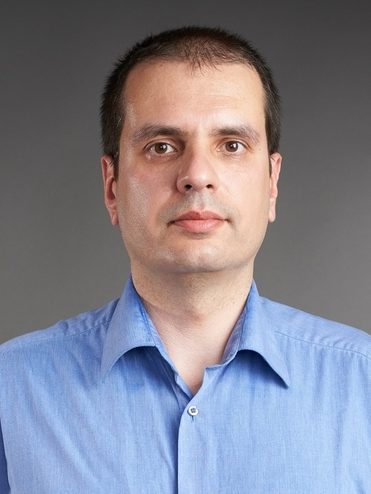
Vladimir Titarev is a Principal researcher at Federal Research Center “Computer Science and Control” of the Russian Academy of Sciences (FRC CSC RAS). He graduated from Bauman Moscow State Technical University (BMSTU) in 2000. He obtained candidate of sciences degree from BMSTU in 2003 (supervisor – Professor E.M. Shakhov) and Ph.D. degree from University of Trento, Italy in 2005 (supervisor Professor E.F. Toro). The latter thesis was selected in 2007 as one of three best Italian Ph.D. theses in applied mathematics (INDAM-SIMAI award). After working at Trento University, Italy and Cranfield University, UK, in 2011 V. Titarev joined FRC CSC RAS (until 2015 – Dorodnicyn Computing Centre of Russian Academy of Sciences). On April 12, 2018 he presented his habilitation at Keldysh Institute of Applied Mathematics (Moscow) and was awarded Doctor of Sciences (DSc) degree.
In recent years V. Titarev has been principle investigators in projects with the Russian Foundation for Basic Research, the Russian Science Foundation and the Russian Space Agency. Up to date he has published approximately 100 journal papers (Scopus H-index h=28).
Scopus: 6602376762
ORCID: 0000-0002-7106-0049
Publons: https://www.webofscience.com/wos/author/record/G-5161-2014
Research interests
V. Titarev is a specialist in the field of computational fluid dynamics and associated numerical analysis. His research track record and interests include the Boltzmann equation with model collision integrals, hyperbolic conservation laws and numerical methods, very high-order essentially non-oscillatory methods in particular, for partial differential equations with applications in gas dynamics, rarefied flows, reactive multiphase flows as well as non-linear elasticity.
RGD topics
- Boltzmann and related equations: mathematical properties of the Boltzmann equation, proofs of existence of solutions in particular cases, model kinetic equations
- Aerospace. Examples include high speed flows, shock waves, nozzle expansions, high altitude aerodynamics.
- Jets and plumes
- Internal flows and vacuum systems
- MEMs and NEMs